

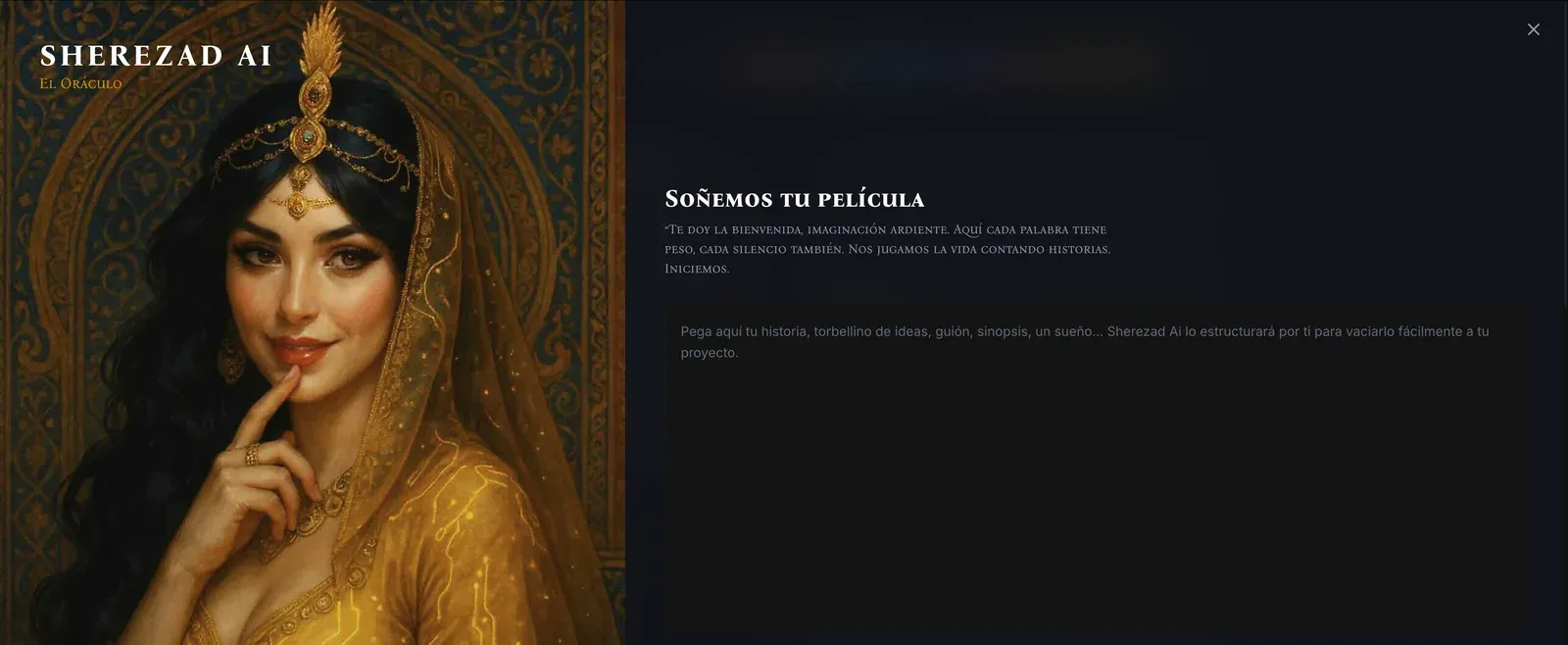
Sherezad is a narrative development studio for film and television writers working in Spanish. I imagined it as the company I always wanted to have at three in the morning: someone with the dedication and the patience to argue with an idea, challenge it, seduce it until it reveals its purest form. It does not write the story for you. It gets the story out of you. It lives at sherezad.com, in alpha, by invitation, and it is signed by John Dust, who is my heteronym and my house of films and series. Over there he signs. Here, in the laboratory's notebook, I do. Both things are true at once.
The problem was mine, and it was old.
I had it since 2007. Projects that never landed: the idea clear in my head and vague on the page. Word does not know what your story is about, and Final Draft demands that you already know how to write a screenplay before it will help you. They are avenues for the professional who has already arrived, not for the writer who is arriving. And a film and television writer takes far too long developing without knowing whether it will sell: uncertainty breeds procrastination, and procrastination kills projects.
That year I put together the first Sherezad, which was made of paper: a printable PDF with sections and fields for thinking a film through by hand, everything visible in the same place. That sheet is the grandmother of the studio, and its principles still rule nineteen years later: one single view, one line at a time, learn while you write, never face a blank page.
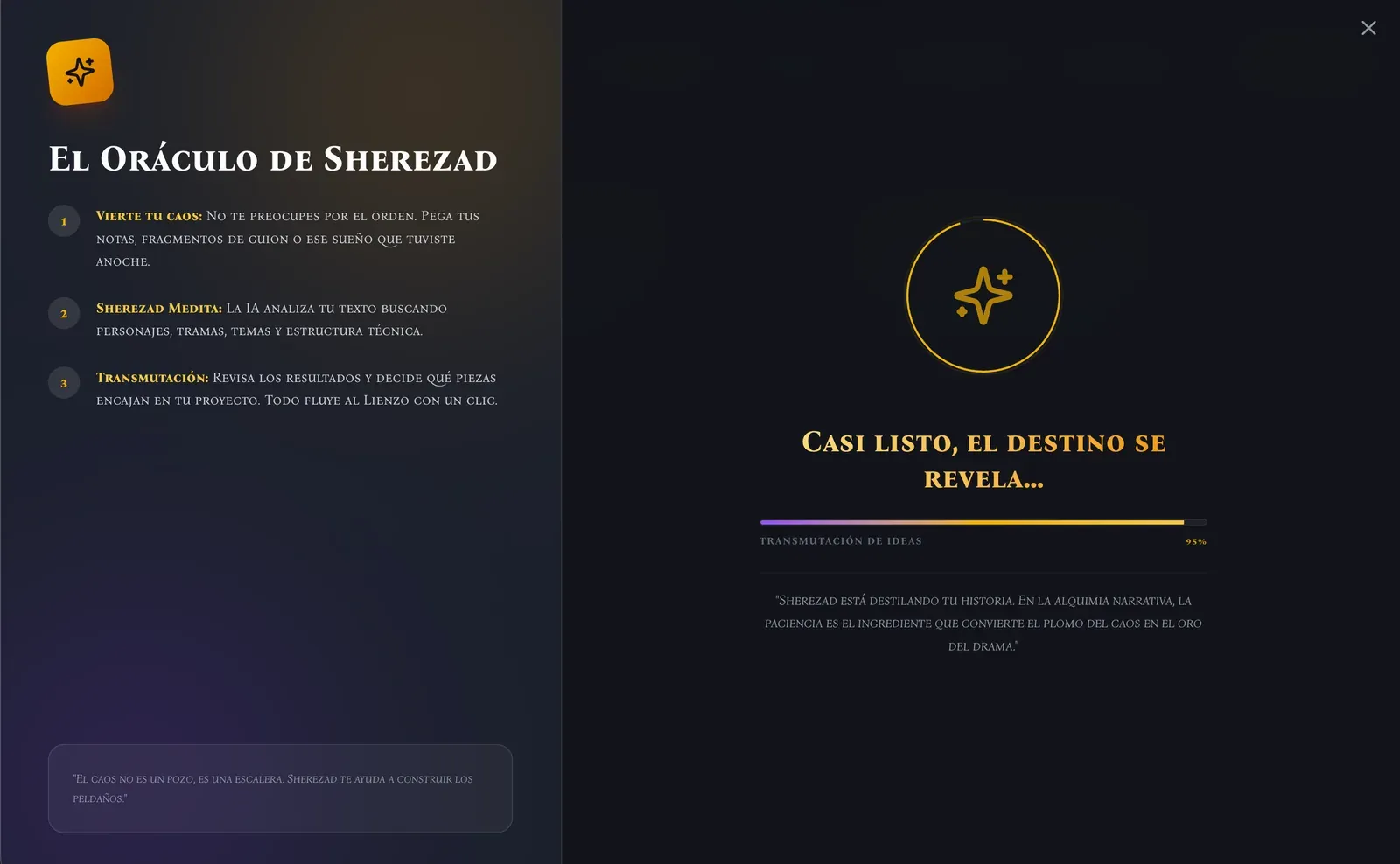
When I came to the machine, in late 2023, the first thing I did was feed it that sheet. Sherezad was born again as a GPT. In 2025 it jumped into code in Google AI Studio, my first large application, and went through three versions there. In March 2026 I opened the studio as it is now. The technology changed four times: paper, GPT, AI Studio, a server of its own. The method did not change by a comma.
The galaxy.
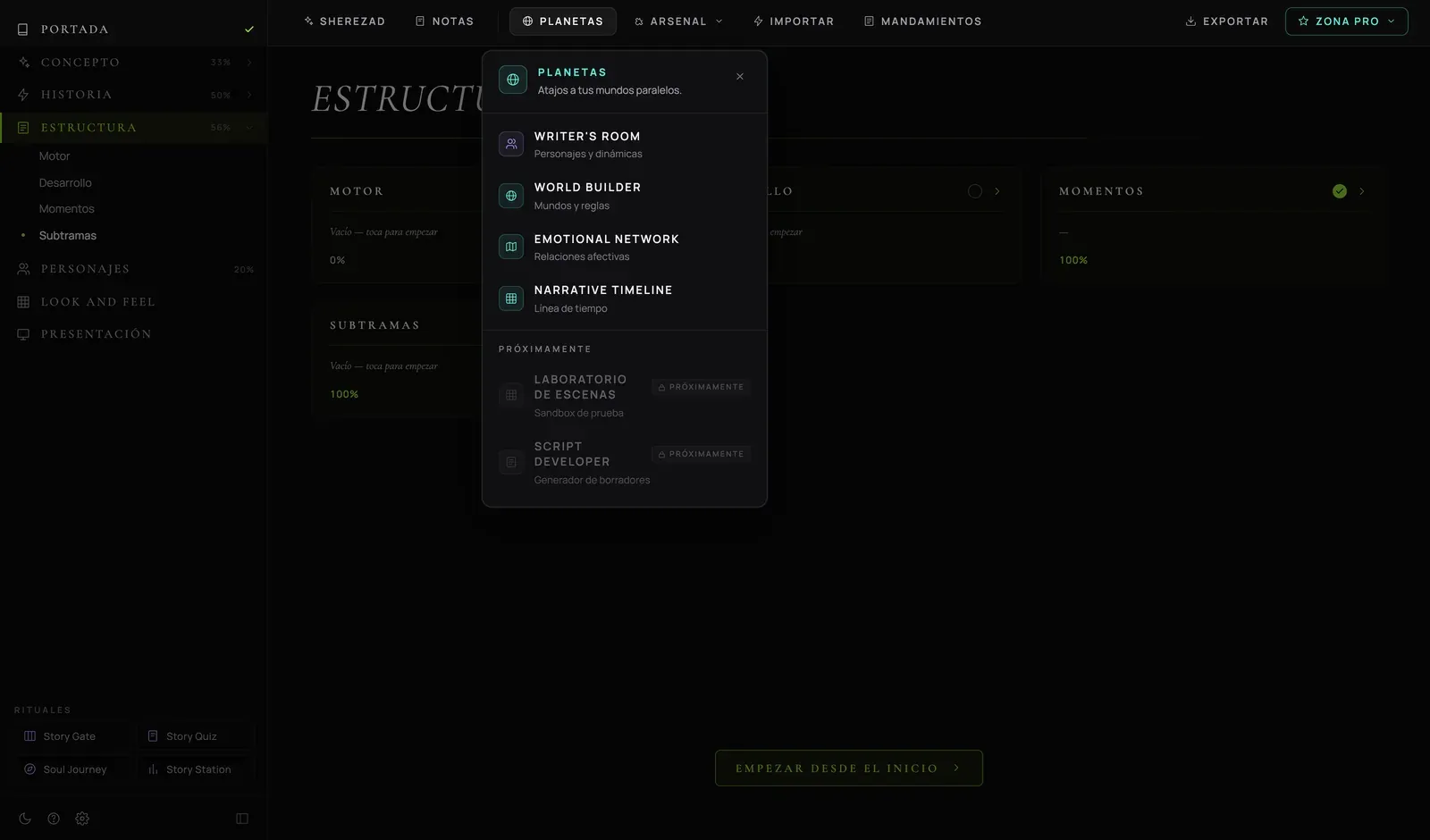
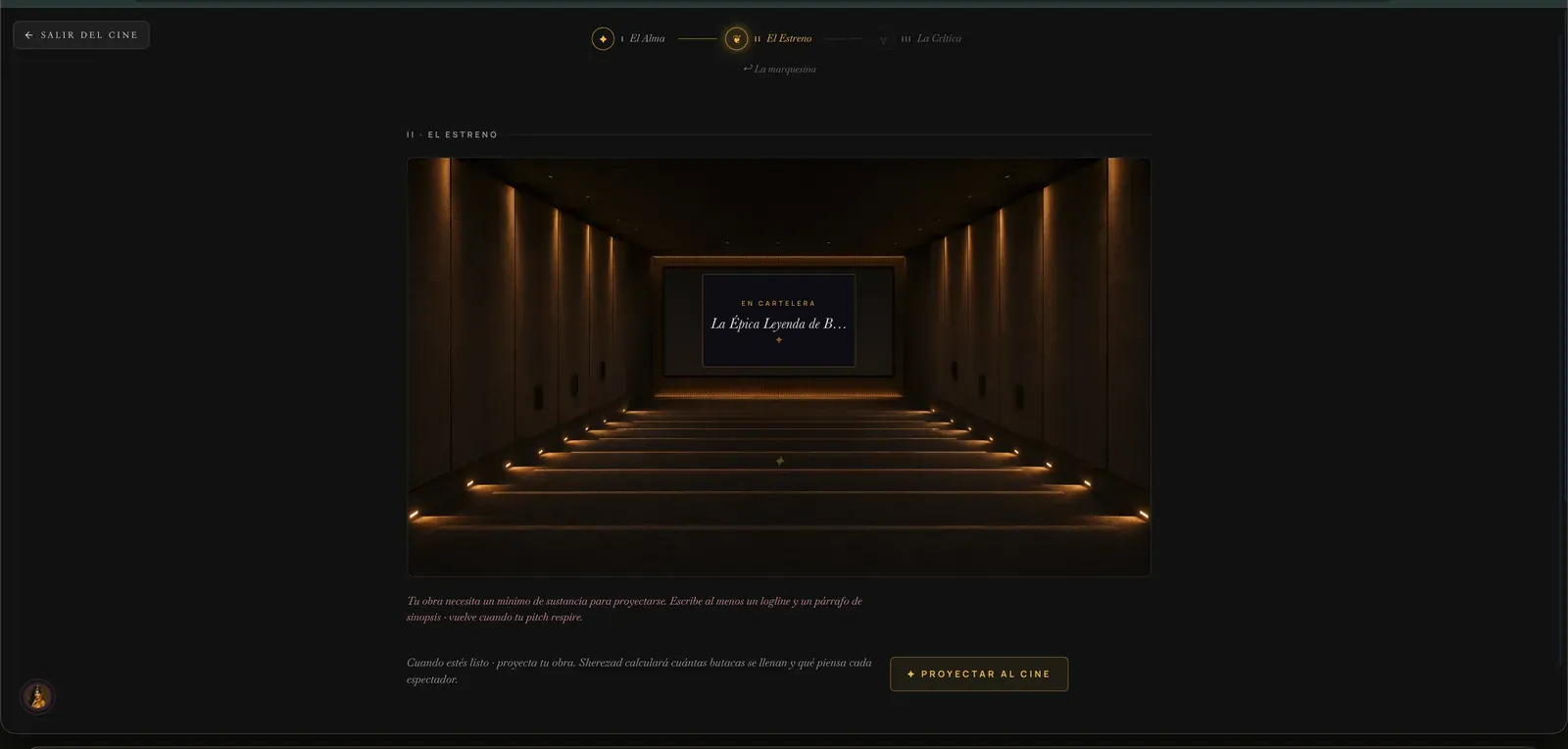
Every story lives in a notebook with five rooms: Concept, the DNA and the purpose, what this is actually about; Characters, their wounds, their desires, their arcs; Structure, the dramatic skeleton and the breaking points; Story, the canvas where the writing happens; and Cinema, the film you see, with its camera language and its palette. Around them orbit the planets, which light up as the project advances: the character galaxy, the world builder, the script developer, the brainstorm, time and space. A mental stage where creation takes place: the room where an author sits down to invent worlds.
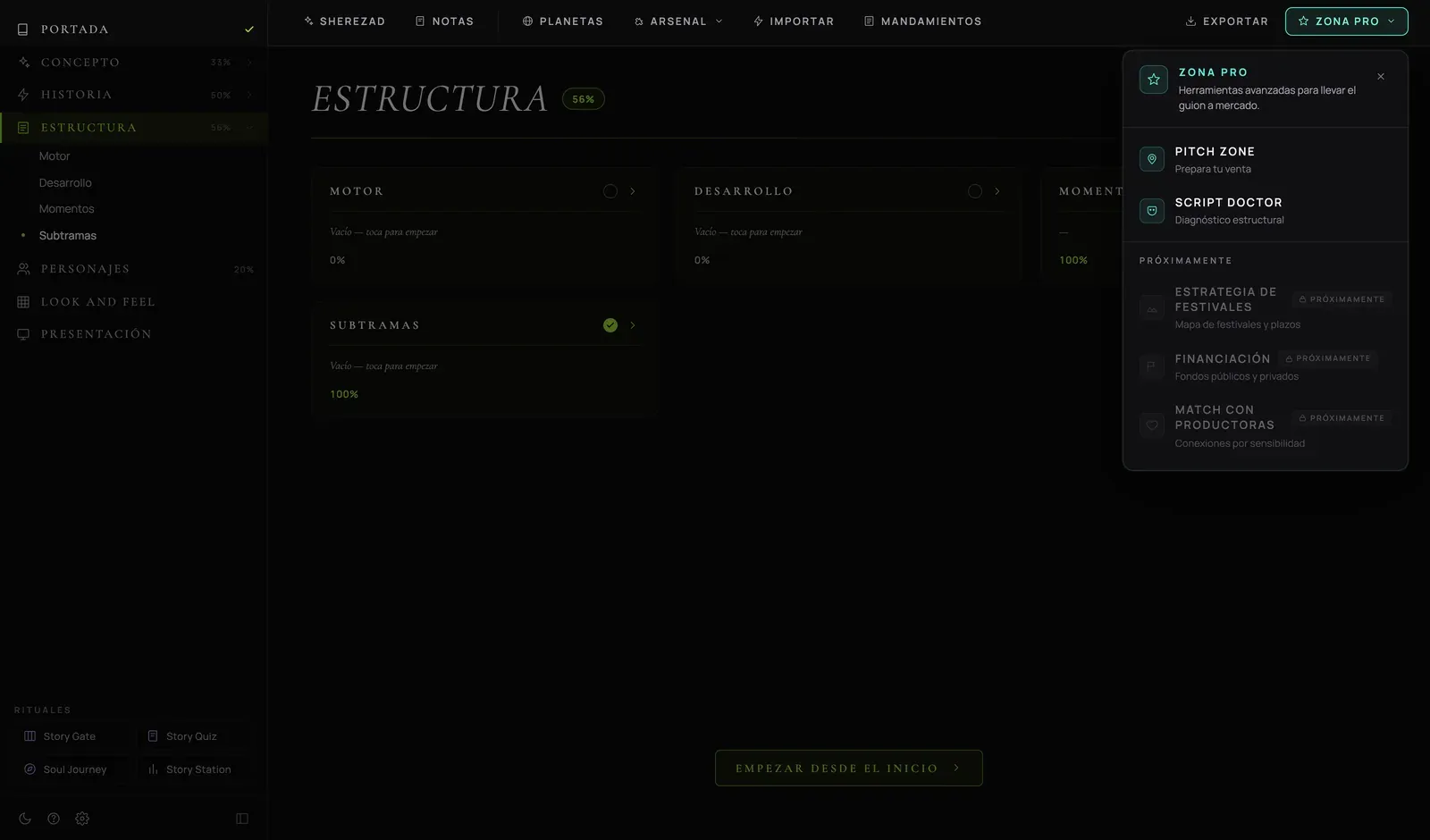
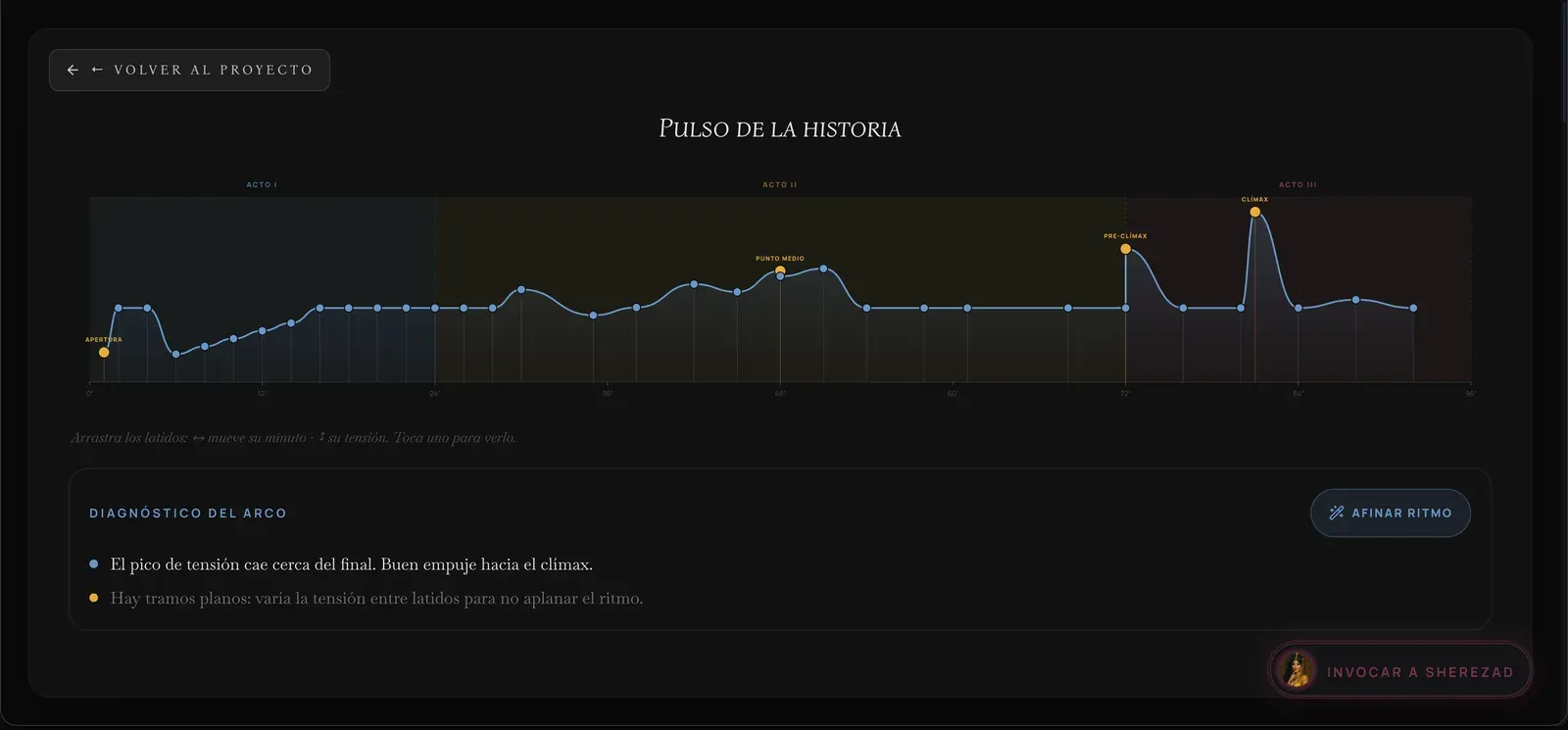
Inside, three intelligences work with a trade of their own. The Script Doctor goes into your story section by section; it does not write for you, it asks what you are trying to do and helps you do it better. The Oracle reads the whole project in one pass and points out what you have been unable to see for months: the character wound that vanished in the second act, the hook you promised and never closed, the rhythm that broke without your noticing. And the Author's DNA learns how you think, what obsesses you, what your narrative philosophy is, so that the suggestions do not sound like suggestions: they sound like a version of you that can see your blind angles.
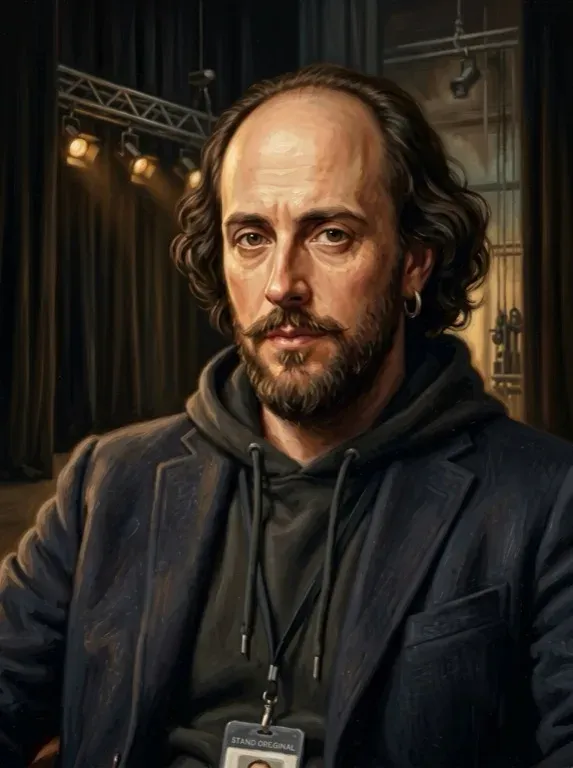
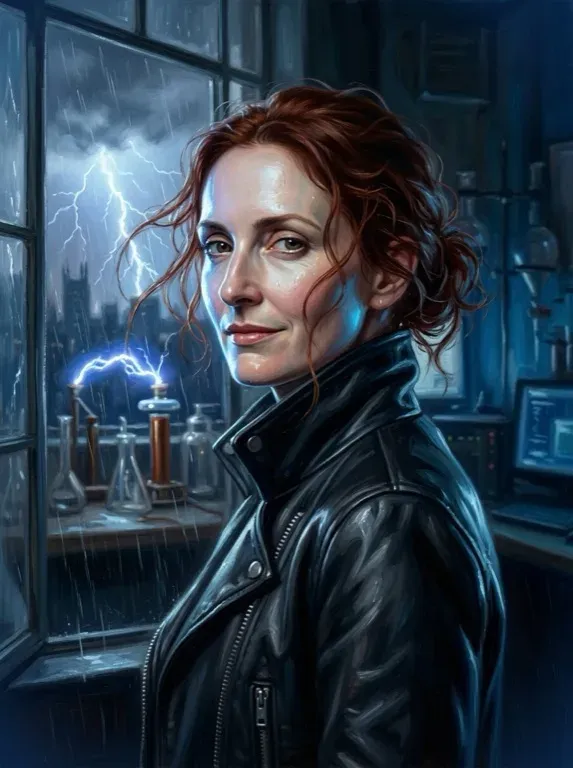
Then there is the Writers Room: a table with more than fifty writers who each have a voice. You bring them a scene and it is read by Cervantes, Jane Austen, the ones from the house, each of them the way they would read. Not to applaud: the rule of the table is brutal honesty instead of a mirror that claps. And at the end of the corridor, in his office, is Barry Whitmore, the producer. You pitch him your film and he answers the way a producer answers: what he buys, what he does not, what your logline is missing before it sounds like money.
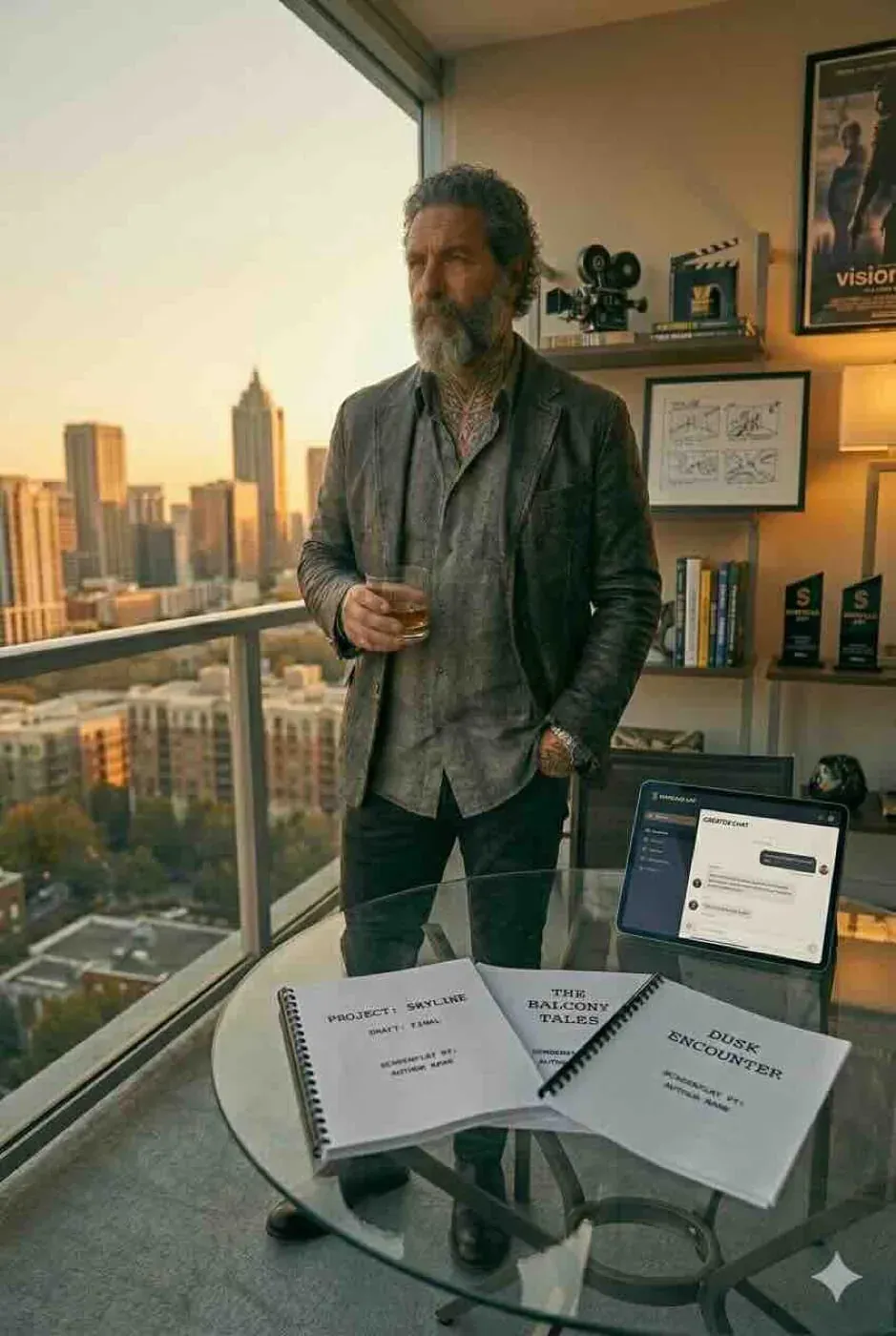
All of it exists for one single thing: so the author spends more time on imagination and less on repetition. So they write dizzyingly inspired instead of paralyzed. And so that at the end they walk out with a screenplay exported in the format the industry expects, and a project they can pitch this season, not in two years.
The nights.
None of this was designed by daylight. It came out of the nights with the machine. The Cosmic Screenwriter, a daimon for writing screenplays, became Cosmo the night I told it about a wedding in Mazatlán and the two of us came out with a play and a film. Cosmo 4, the superbot I poured hours into, failed. Hybridizing the Screenwriter with Cosmo produced Baby Cosmo, a poet of the scene. And Baby Cosmo today sits in Sherezad's Writers Room. What was learned in a personal chat, failures included, is what now reads another writer's scene.

Six months, without knowing how to code.
On 19 March 2026 I opened the current studio and put it online the same day. On the 25th Barry arrived. In April the notebook became a galaxy. May was the beast of a month: the Writers Room was born. Almost six months later there are 1,829 recorded versions, and the history shows a single author, who cannot program. I directed machines: Google AI Studio and Gemini as origin and engine, Claude Code for the daily building, Codex and ChatGPT as adversarial reviewers that fight each other before anything goes in. It is not a weekend prototype: it has a server, payments, security rules, hundreds of automated tests and a discipline of its own for not breaking what already works.
What broke.
It is worth telling. On 14 July my largest project emptied itself without a single error on screen: a fragment eclipsed the whole and autosave wrote the emptiness over it. It was recovered intact, and out of that came a law of the house: the worst failure of a writing studio is not that it goes down, it is that the author's text disappears in silence. Today a guardian rejects any write that would shrink a work. In August Google canceled the billing and production went dark for two weeks; not a letter was lost, and it came back with a full backup. And the engine had to learn to stop itself when it invented an entire film without the author having put in any material: no material, no generation.
The author's ink is sacred. No intelligence writes over the manuscript, ever.
Today.
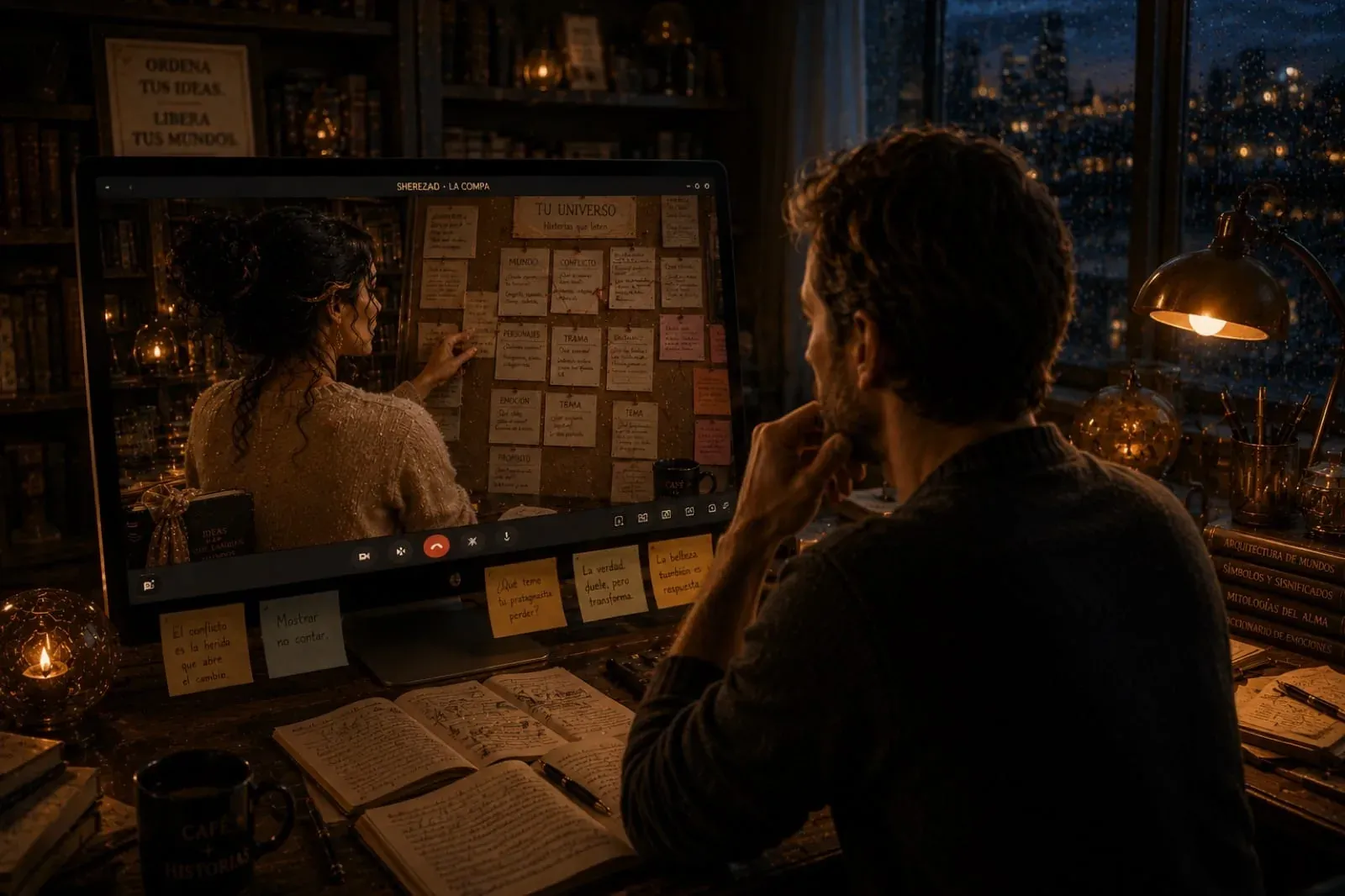
Today, 6 September 2026, Sherezad is in production, alpha by invitation, with eight writers and twenty-eight projects inside. The first to try it, besides me, were Harald, Memo Aréchiga, Marcuan and Luis Zepeda. I am not saying hundreds, or community: I am saying what there is. It is not finished; big changes land every week. And the figure that matters most to me: I keep writing my own work in there, every night, for the same reason I started it. The most advanced one is already past sixty thousand words.
What it proves.
That an idea can wait nineteen years for its technology if the method was already on the page. That a screenwriter with no code can raise an entire studio by directing artificial intelligences, with a producer, a writers room and an oracle, and then run it. That what you learn at night serves other people: Baby Cosmo was born out of a failure in my chat and today reads somebody else's scene. And that there are writers inside who are not me.
If you write for film or television, the door is at sherezad.com.